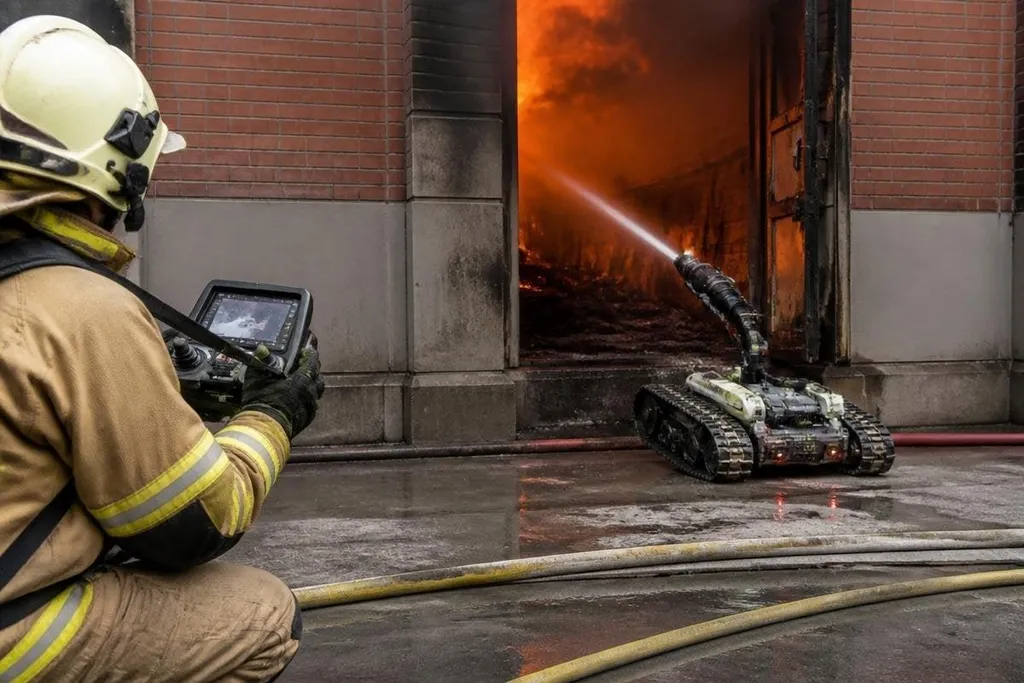
A firefighting robot can enter a burning building while its operator stays outside. Its job is to send back video, heat data, and water from a place too dangerous for a person.
The machines are built for a narrow task: reach the fire, help crews see what is happening, and reduce the time people spend near heat, smoke, and falling material.
Quick read
- Tracked robots can cross debris and wet floors that may stop wheeled vehicles.
- Thermal cameras show heat through smoke, but they don't replace a full view of the room.
- Remote water control keeps firefighters farther from the fire while the robot works.
What the robots do inside a fire
Most firefighting robots use tracks rather than legs. Tracks spread the robot's weight across a wider area, which helps it move over broken flooring, hoses, and small pieces of debris. The design also keeps the robot low to the ground when it pushes through smoke-filled spaces.
A remote operator guides the robot with cameras mounted on the vehicle. A thermal camera shows hot surfaces and people through smoke that may block a normal camera. That heat picture lets the operator find a person, check a doorway, or locate the hottest part of a room.
The robot may carry a water cannon or another nozzle. From a safer position, the operator aims the stream, often outside the building or behind a protected vehicle. Water flow still depends on the hose, pump, and nozzle, so the robot doesn't remove the need for a working water supply.
That detail matters at a fire scene. A robot can reach the room, but it can't fix a failed pump or decide how much water the building can take before its structure weakens.
Why remote control matters
Firefighters already use protective clothing, breathing gear, and careful entry plans. Those tools reduce danger, but heat can rise faster than a person can retreat, and smoke can hide changes in the building.
A robot gives the crew another option. It can enter first, send video back, and keep a water stream on a fixed area while people prepare the next move. If the building becomes unsafe, the crew can pull the robot back without sending someone in to retrieve it.
Remote control also creates limits. Smoke, walls, metal doors, and damaged structures can weaken the radio signal. When the link drops, the operator may lose video or control. A robot that cannot receive commands needs a safe stop or return mode, and the exact behavior depends on its design.
A fire service buyer needs the test conditions behind a working video. Firefighting robotics coverage from Robot24.com can name the machine, site, control link, and response after contact fails. Those limits become harder to manage inside a burning structure.
Where the machines still struggle
Firefighting robots are heavy tools, not small inspection gadgets. Their tracks can handle some debris, but stairs, narrow doors, collapsed passages, and overhead hazards can stop them. A vehicle that reaches the building entrance may still fail to reach the room that needs help.
Heat also affects the robot itself. Cameras, cables, motors, batteries, and seals all have temperature limits. A cooling system may protect the electronics, while water around the vehicle can create slippery surfaces and hide holes in the floor.
The operator must read several feeds at once while controlling movement and the nozzle.
That work takes practice. A camera view can make a doorway look clear when the floor beyond it has collapsed, and a thermal image can show a hot object without explaining why it is hot.
I’d judge a firefighting robot by its recovery plan before its top speed. A machine that can stop safely, keep its link, and leave under control is more useful than one that reaches the fire quickly and becomes stranded.
A practical check before deployment
A fire department comparing robots should check these points during a live trial:
- Access: Test door widths, ramps, stairs, hose crossings, and wet floors found in local buildings.
- Control link: Measure video and command performance behind walls, inside basements, and near metal structures.
- Heat protection: Check the stated temperature limit for the camera, motors, battery, and control box.
- Water system: Match the nozzle, hose, pump, and flow rate to the department's existing equipment.
- Recovery: Confirm how crews retrieve the robot after a stalled motor, damaged track, or lost radio link.
- Training: Give operators repeated runs with smoke, low light, debris, and a blocked camera view.
Those tests connect the robot's design to the buildings and equipment a crew already uses. A demonstration on a clear concrete floor proves very little about a damaged apartment stairwell.
Firefighting robots will keep their value in the first minutes of a dangerous call, when crews need information and distance. Their next test is practical: can departments deploy them often enough, train operators well enough, and recover them when the fire makes the plan change?